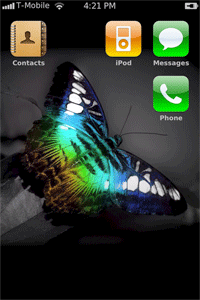
Read me first
Page 1 of 4
I have a lot of content on this site so I made these pages as an introduction to the iPhone hacking scene. Consider it a good starting point for what I have to offer. My tutorials require an Intel based Mac.
These are the topics I will cover:
- What is jailbreaking, and why should I do it?
- How is unlocking different from jailbreaking?
- What jailbreaking has to offer.
- Let's jailbreak and unlock!
- Jailbreaking issues.
- iPhone models.
- What firmware is jailbreakable/unlockable?
- Why are there five categories of Step 1 tutorials? Which is the right one for me?
- How to retrieve firmware files directly from Apple.
- Downgrading firmware.
- What is an ECID SHSH and how do I save it?
- Step 2: I've jailbroken, now what?
- What else does your site offer?
What's jailbreaking, and why should I do it?
Jailbreaking is a process where you modify your iPhone so that you can purchase and install programs from any software company you want to. The term jailbreaking refers to the fact that the code running on the iPhone is in a programming jail so that it can't be modified by the end user (you). Without getting too technical, all the programs on the iPhone run inside of a programming sandbox. This sandbox only allows Apple approved software (purchased through the App Store) to be installed.When you jailbreak, you add the ability to run non-App Store purchased programs. By bringing your own programs to play with in the Apple sandbox, you greatly increase the functionality of the iPhone.
Let me put this to you another way... I own an Apple laptop computer. I want to purchase the Adobe Photoshop program. This is a powerhouse image editing application and isn't in the Mac App Store. Apple allows me to go to Adobe directly and purchase Photoshop from them and then install it on my laptop computer. What's the difference who I purchase my iPhone programs from?
Most new "features" on the iPhone (including the very App Store itself), in stores right now, came from the jailbreak community. Some of these features are: custom ringtones, custom wallpaper on the home screen, cut and paste, Notification Center, large format app switcher, toggles for services like Wi-Fi, et cetera. The jailbreaking community has constantly innovated features that users want for the iPhone. Apple continually incorporates these features into upcoming models of the iPhone as a selling point. The jailbreak community has even patched serious flaws in the iPhone when they discovered them to help protect jailbreakers. Apple then includes these patches in their future software releases to protect its customers.

Jailbreaking an iPhone is legally allowed. The Library of Congress included jailbreaking as an allowed exemption to the Digital Millennium Copyright Act (DMCA) as found in the United States Code of Federal Regulations, Title 37 Part 201.40, in 2010. You can read their ruling here. Paragraph 2 specifically applies to this. Note that jailbreaking was never illegal. This decision only gives end users legal grounds to jailbreak, not that they need protection from something.
Jailbreaking is generally safe for your iPhone and cell phone network. Thousands of beneficial applications exist in Cydia. These apps are only available via jailbreaking. The app approval process at Apple doesn't always make sense, and just because an app made it through the Apple approval process doesn't necessarily mean that app is safe either. Apple likes to claim they're protecting the iPhone's security, and that of their cell phone network partners' security. I haven't heard of a single issue where a cell phone network was compromised because of jailbreaking or unlocking, and jailbreakers have been doing this since 2007!
Jailbreaking is a generally risk-free process that will not void your warranty, provided you can restore your iPhone with iTunes. After restoration the jailbreak is removed. Jailbreaking is a transparent process. Everything that Apple provided on your iPhone should continue to work normally once you have jailbroken. Please don't let naysayers limit what you do with your phone in the name of privacy and security as the App Store has failed numerous times in these arenas.
How's unlocking different from jailbreaking?
While jailbreaking lets you use any programs you want to on your iPhone, unlocking is an additional process performed on an already jailbroken iPhone. Unlocking is removing the restriction put in place by Apple that limits the iPhone to operating on a particular cellular network. You can always roam, but at greatly increased rates of service. When you unlock an AT&T or a T-Mobile iPhone, it allows it to operate on any network in the world that uses the GSM standard (the most widely adopted cellular phone standard on the planet). You simply remove one SIM card and insert the SIM card of the network you want to use and the iPhone will connect to that network.
Unlocking (from a CDMA perspective) doesn't apply to the Sprint or Verizon networks. These providers must provision your iPhone to work on their network. You can't just run an unlocking program to gain access to their network at will, like you can with GSM networks. iPhones that use GSM technology only can't be made to operate with CDMA network providers.
The Digital Millenium Copyright Act (DMCA) no longer protects the ability to unlock a cell phone purchased locked from a carrier beginning in January of 2013. Because of this, new unlocking tutorials will no longer be provided on this site beginning with the iPhone 5. Unlocking iPhones purchased prior to 2013 is still allowed and those tutorials are still available.
Keep in mind AT&T (and presumably T-Mobile) will unlock the iPhone. Sprint and Verizon models come with the GSM SIM slot unlocked and you can purchase a factory unlocked iPhone direct from Apple. So you have plenty of options. You'll also have a warranty protecting that unlocked iPhone. Since Apple has made it so easy to purchase a new, unlocked iPhone with a warranty, I'd recommend this method of obtaining one.
There are two types of cell phone service providers in the United States: those that use GSM technology (AT&T, T-Mobile, H2O, Net10, Simple Mobile) and those that use CDMA technology (Verizon, Sprint, Cricket, Boost). There are probably other smaller regional carriers as well. They are also divided into these cateogries.
What jailbreaking has to offer.
While Apple's App Store is fantastic, it won't provide you with many amazing programs that you can install once you are jailbroken. In fact, there are many programs you will never see on the App Store because of Apple's strict and often capricious rules for approval. Cydia (an alternative to the App Store) is the program that is automatically installed when jailbreaking and the vast majority of the content it offers is free!The iPhone hacking community is well established and has been around since the days the first iPhone went on sale in the summer of 2007. With the creation of Installer, and then later Cydia, the community created the foundation for the distribution of third party applications. Apple saw this and witnessed the success of this distribution model. They were a driving force behind the creation of the App Store (so much for web apps huh, Steve?). Apple was then able to monetize the distribution of third party software on the iPhone.
So what're some of these programs?
|
How'd you like to tether with your iPhone, without a tethering plan? iPhones are already required to have a data plan by all carriers, so why should you have to pay a second time to use that same data? This is a convenient feature when you're on the go, and there's no Wi-Fi to be found for your laptop computer or iPad. You can tether with any carrier provided you already have a data plan. There's a couple of programs for sale in the Cydia store that can help you with this: MyWi, and TetherMe. |

|
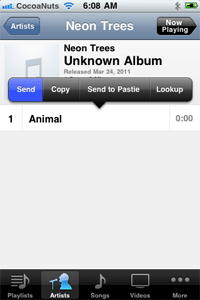
Bluetooth file transferring has been available on many cell phones for years. It's been lacking on the iPhone until now. The program is called Celeste Bluetooth File Sharing and allows for transferring of photos, music, contacts, iBooks and voice memos. It will work with any phone or computer that supports OBEX Bluetooth file transfers. This program is for sale in Cydia.


How would you like to use FaceTime over your 3G connection when you are on the go, instead of being restricted to Wi-Fi? Well if you jailbreak you can! All you have to do is purchase the program called 3G Unrestrictor. You can also download programs larger than 20 megabytes from the App Store over 3G, which is normally restricted to Wi-Fi only.


If you like voice control over certain functions on your iPhone, imagine being able to speak a word and have the iPhone load your favorite website. How about being able to open applications? You can even take a screenshot with just a word. This program is for sale on Cydia. You can program many of your own custom functions with the VoiceActivator program. See a demonstration below.
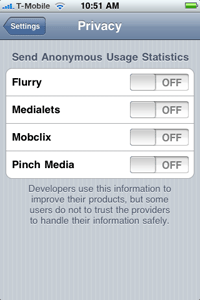
Would you like to have the ability to opt out of data mining services which have their code embedded in some App Store applications? The reasons for this data mining seem harmless enough, developers just want to track how users use their program. If you would like the option to not be tracked, you can install a program called PrivaCy. This program was made by the creator of Cydia and in conjunction with the data tracking service companies in question. Once installed, you are presented with a control panel for opting out of each individual service.


|
There are free games written specifically for jailbroken iPhones like MacMan. This is only available via Cydia. |
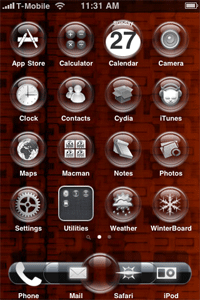
WinterBoard can "theme" the look of your iPhone with just a couple pushes of a button. Take your stock iPhone from this, to this, to this. These themes are called Glass Orb and Chromatic Neon, and can be found in Cydia.


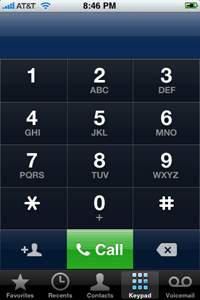
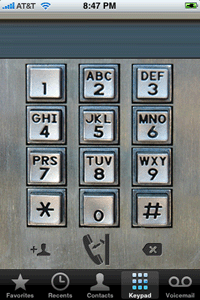
Since this is a phone, and you’ll be spending a lot of time dialing phone numbers, why not change the phone keypad as well? The standard phone keypad sure is rather plain looking. The keypad in the middle is called Retro Phone Dialer. The keypad on the right is one I made with my own photograph.

Who says your lock screen can only show the time and date? LockInfo and WinterBoard to the rescue. You can add practically anything to the lock screen like weather, and status on your e-mail, voicemail, SMS, RSS feeds et cetera.
Starting on the top row, the left photo is the stock lock screen, the middle photo is the LockInfo program (with a different slider), and the third photo is using WinterBoard with a theme called LockMS (with an invisible slider). The second row on the left is the LockMS_Weather theme, the middle photo is the wĕdaPanel theme which has a lot more weather information to display, merely be tapping on the lockscreen, the final photo is another variation of the LockMS_Weather theme.


If you jailbreak you can even change the fonts system wide! While Apple provides three fonts for use with the Notes application, you can add many others to suit your taste.


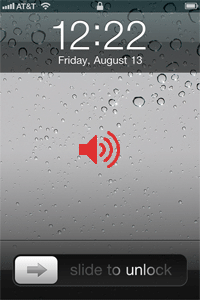
| You can customize the audio sounds on your iPhone when you slide to unlock, dial a phone number, receive a new email or SMS and relock your phone just to name a few. Why be stuck with the same exact sounds that every other iPhone has? There are many WinterBoard themes that can do this, or you can use SSH to do it yourself. |
|
Apple has lots of features on the iPhone that can be turned on and off. The problem is these
buttons are all buried in different menus and it can be confusing where to find them quickly, or
just tedious to have to do over and over again.
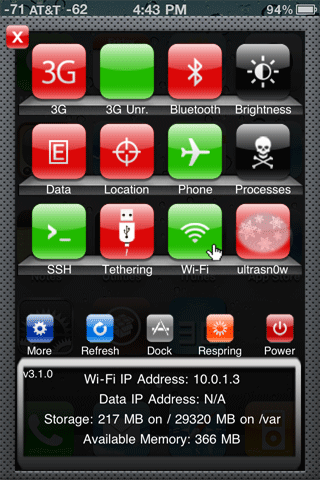
There’s a program called SBSettings, which adds a convenient control panel to the iPhone. It is a one stop shop for turning on and off various services on your phone like: 3G, Edge, Wi-Fi, Bluetooth, SSH, Airplane mode, GPS location, adjusting screen brightness, killing processes, SSH, Tethering, et cetera. It is activated by simply swiping your finger across the status bar. Note at the very top of the screen I have enabled numeric displays for my cellular signal strength, Wi-Fi signal strength, and battery strength instead of using the traditional graphics. This is another feature of this program. SBSettings also has a control panel for hiding the various program icons installed. If you are like most people who don’t use the Stocks application, you can just make it disappear by sliding its toggle to off. There are a plethora of options to explore in the completely free and amazing program. |
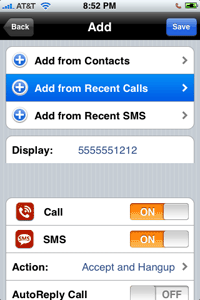
| One of my favorite programs is iBlacklist. It allows you to selectively block incoming calls from phone numbers that you don't want bothering you. This is great for blocking telemarketers, or around election time. You can also use it to block text messages. There is a similar program called MCleaner. Both applications are fee based. | 
|
|
Another little known fact is that the iPhone is limited to eleven pages of icons. Once you reach this limit, any new programs you install through the App Store will not display on the iPhone, so you won't have any way to run those programs unless you do a Spotlight search for them. With 4.0 firmware Apple finally introduced folders, but implements them in a limited way: you can only have 12 icons in a folder. Why this limitation?
If you jailbreak, you can use a program called Infinifolders, which allows an unlimited amount of applications in a folder! If you buy more programs from the App Store, no problem. When you go to sync your iPhone through iTunes, the new application is placed on the next avaialable page of your iPhone and you just simply drag it over to the folder you'd like it in. This is a paid program in Cydia. Here's my before and after. Twelve icons on the left, and you can just see the thirteenth icon on the right. The window scrolls to display more than twelve icons. It really works.
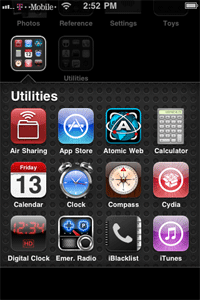

If you really like cramming your screen full of icons you could install the programs Five Icon Dock, Five-Column SpringBoard, and Five Icon Switcher.


If you'd rather see just how few icons you can have on your screen, or be able to arrange them in any pattern you'd like (with gaps), then check out the Gridlock program. I've made my dock, the spotlight icon and the page dots disappear with other themes.